About
Work that holds.
Control belongs inside the architecture.
Freedom belongs with the operator.


The Mark and the Riser
You see it. You own it. We answer for it.
It's the shape of who we are, so we drew it. Our mark is three uprights - each structural and unique.
| seen | The work is visible while it happens, not summarized afterwards. |
| owned | Every decision has a named owner and a recorded reason. |
| answerable | Ask why at any point and get a real answer, with the evidence attached. |
The strongest sits in the middle: answerable. It reaches up through the broken lintel, because nothing we build closes over the person running it. We named it Spine.
What Cognita Means
Known. Understood. Operational.
Cognita is the feminine form of the Latin cognitus: known, understood. For us, understanding is operational. It means knowing where data lives, who has authority, what changed, which rules apply, what evidence exists, how access is controlled, how human judgment is preserved, and how a system behaves under pressure. The platform is controlled enough to serve the human, never the other way round.
Control for freedom.
Our systems are not designed to control people; they are designed so the rightful human or organization remains in authority inside the system.
Governed engineering.
Secure engineering is about how work is structured, reviewed, made traceable, and held accountable, not only about tools.
Operational reliability.
Complex systems must perform under real conditions, not only in clean diagrams, so we build for maintainability, handoff, observability, and recovery.
The House
The people who scope the work build it.
Principal Automation Architects.
SMEs and consultants, twenty years and up, cross-trained across platform, network, security, and automation. Not staff augmentation. Not interchangeable seats.
Architects who span the stack.
A platform exit moves the network, the virtual desktops, the ITSM integration and the security policy with it. The usual answer is four specialists and three handoffs. Ours is architects who each span the stack.
Every engagement under Spine.
The architect directs; Spine handles the repeatable work under review, traceability and test gating, and the record is kept as the work happens.
Credentials and partners
On the record.
Engineering certifications held in the house
Ecosystem
Webber designs Sovereign Systems. Cognita makes them operational.
Designs and owns.
A portfolio of Sovereign Systems for high-stakes decision environments, built through Coherent Systems Design. Webber proves it by design.
Makes them operational.
Secure Governed Engineering for complex operational systems, moving them from architecture to operational reality. Cognita proves it in production.
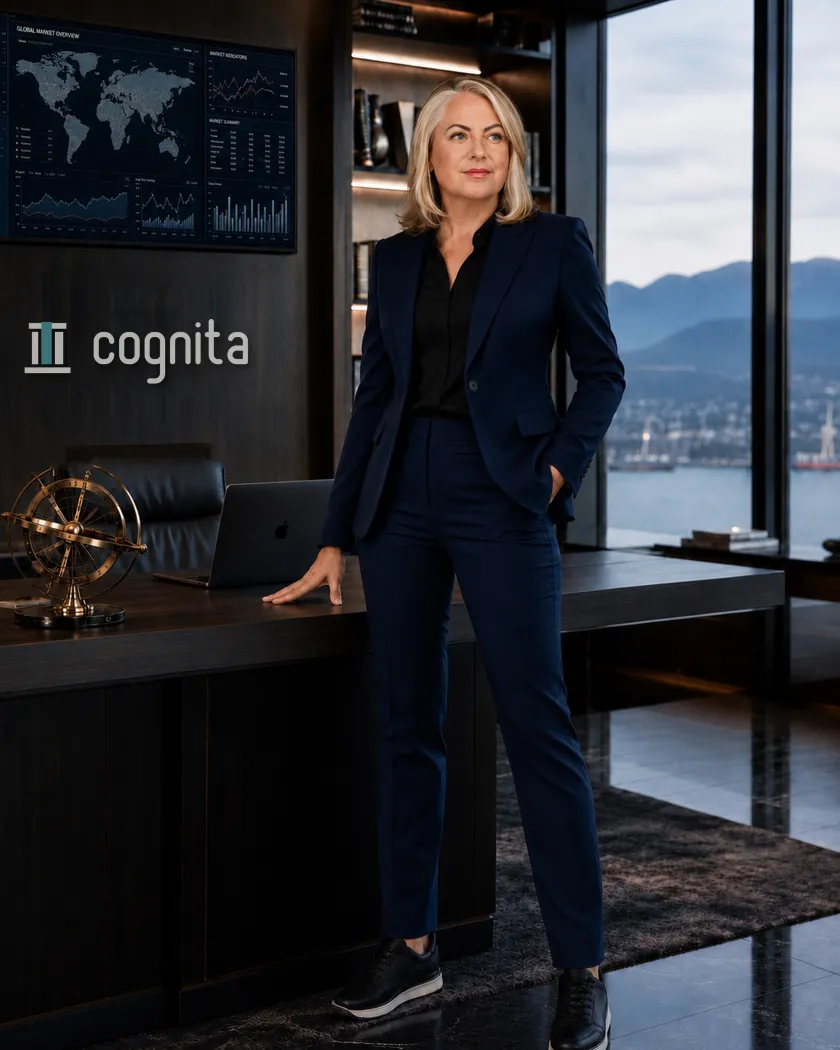
Founder and Global CEO
Rachael Babcock.
Rachael Babcock is the Founder and Global CEO of Webber and Cognita. She leads from the whole system: company strategy, revenue, engineering, transformation, international expansion, and operational delivery. Her executive advantage is systems architecture: seeing the full operating model, identifying the leverage points that determine performance, and aligning information, incentives, and authority around measurable outcomes.
Over more than 25 years, Rachael has led companies, revenue, engineering, growth, and transformation across startups, mid-sized enterprises, Fortune 500 companies, and public sector organizations in North America and EMEA, in CEO, CRO, CCO, and innovation leadership roles.
At Cognita, Rachael leads the engineering organization that moves complex systems from architecture to operational reality, and sets its delivery standards. She is the architect of Sentinel, the autonomous financial system with human-on-the-loop (HOTL) decision sovereignty that Cognita engineered for Webber, and of the authority model behind it. Her mandate is to ensure powerful technology is built cleanly, governed visibly, and delivered with the discipline required to create durable enterprise value.
From the Desk of the CEO
Complex systems do not become yours because they are controlled. They become yours when control belongs inside the architecture and freedom belongs with the operator.
The next decade will test organizations not only on how quickly they adopt cloud and automation, but on whether they can retain independent control over the data, infrastructure, workflows, access, automation, and decisions they depend on, without forcing people to compensate for bad structure.
That is the work Cognita was built to do.
We operate in the hard middle layer where architecture becomes production: where designs meet access controls, pipelines, integration points, incident patterns, evidence trails, and the people accountable for outcomes.
We apply automation the same way: as a governed delivery multiplier. Under Spine, automation can accelerate analysis, implementation, testing, troubleshooting, reporting, and review while preserving ownership, validation, traceability, and accountability.
Systems under your control require clean engineering. They require ownership that is visible, data that remains controlled, automation that remains governed, operations that can explain what changed and why, and workflows that support human judgment instead of forcing people into rigid platform defaults.
This is why our delivery standard is simple: High Impact. Built Clean.
Founder and Global CEO,
Webber + Cognita
Leadership
Advisors and Officers.
Dr. Gaurav Khanna
AdvisorBuilds platforms on traditional and generative machine learning that automate business processes; at Cisco, led skills-based routing, resource scheduling, and large-language-model knowledge automation. Physics, Yale; M.S. and Ph.D., Materials Science and Engineering, Stanford; teaches at Stanford Continuing Studies.
Tina Valdez
COONearly 30 years scaling technology companies from startups to Fortune 100 in CRO, CIO, COO, and GM roles, with go-to-market partnerships recognized by CRN's Women of the Channel (2020–2022). Ocean Engineering, U.S. Naval Academy; MBA, University of Colorado Leeds School of Business.
Carl Wallace
CFOTechnology commercialization, strategy, and product development for defense and commercial industries; brought CRADA- and SBIR-backed technologies to market and served as Chief Credit Officer at two Washington-area banks. U.S. Marine Corps veteran; B.A. in Management, M.P.S. in Technology Management/Engineering.
Who We Serve
Estates that cannot fail quietly.
Complex enterprises, federal and civilian agencies, and regulated environments where fragmented platforms, legacy dependencies, sensitive data, compliance expectations, and production workloads cannot afford careless change. We work with the platform, cloud, data, and engineering teams responsible for turning architecture into operational reality, and we work best with teams that need to move faster without becoming fragile.